
Customer onboarding automation means using software to handle the repeatable work of welcoming a new customer: reminders, follow-ups, document requests, check-ins and status updates. People then spend their time on the conversations that need judgment. The approach that works is to map your real workflow first, automate the repeatable messages and reminders, and keep a person on anything that grants access or involves a high-value account. That is also how we build at GLPS Memphis: we start by understanding your workflow, then build Project G3 and related tools around it, so the automation fits how your team already works.
TL;DR
- Onboarding automation handles the repeatable steps (intake, reminders, follow-ups, task creation, status updates) so your team is not chasing each customer by hand.
- Automate the messages that tell a customer something. Put anything that grants something, such as access or billing, behind a written check.
- Automation works best on a process that is already consistent, with a named owner, trigger, expected result and deadline for every step.
- Measure time to first value, stalled steps and how many customers need a human rescue, not just how many emails went out.
- A custom, workflow-first build usually fits better than forcing your process into a generic tool.
Table of Contents
- What customer onboarding automation actually is
- Why the first weeks are worth automating
- Which steps to automate
- How to build the workflow, step by step
- A worked example: a services business with a ten-step onboarding
- Onboarding for event hosts: the same logic, a different customer
- Missed calls are an onboarding problem too
- How to measure whether it works
- Common mistakes
- Where a custom build fits
- Putting Project G3 to work on onboarding
- FAQ
- Sources
What customer onboarding automation actually is
IBM describes customer onboarding automation as using software and AI to handle the repetitive tasks of welcoming and setting up new clients, including data entry, routine communications, document collection, scheduling and compliance checks, instead of relying on manual effort.
In plain terms: every new customer triggers the same dozen small jobs. Someone sends a welcome note, asks for a signed agreement, books a kickoff, reminds the customer when they go quiet, and tells the team when a step is done. Automation runs those jobs on rules you set, so none of them depends on someone remembering.
It is narrower than “customer automation” in general. It covers the first stretch of the relationship, from signed deal to the moment the customer gets the result they bought. That window is where most of the friction, and most of the lost customers, show up.
Why the first weeks are worth automating
Manual onboarding breaks in predictable places. A Moxo study reported by The B2B Marketer, based on 300 company responses, found that 56% of B2B companies name operational delays as the main bottleneck, 45% point to coordination problems between internal teams and 41% to over-reliance on manual processes.
The same report found that 93% of marketers see automation as the key to onboarding success, yet 56% still experience process delays. Wanting automation and getting it to work are different things, which is why the design matters more than the tool.
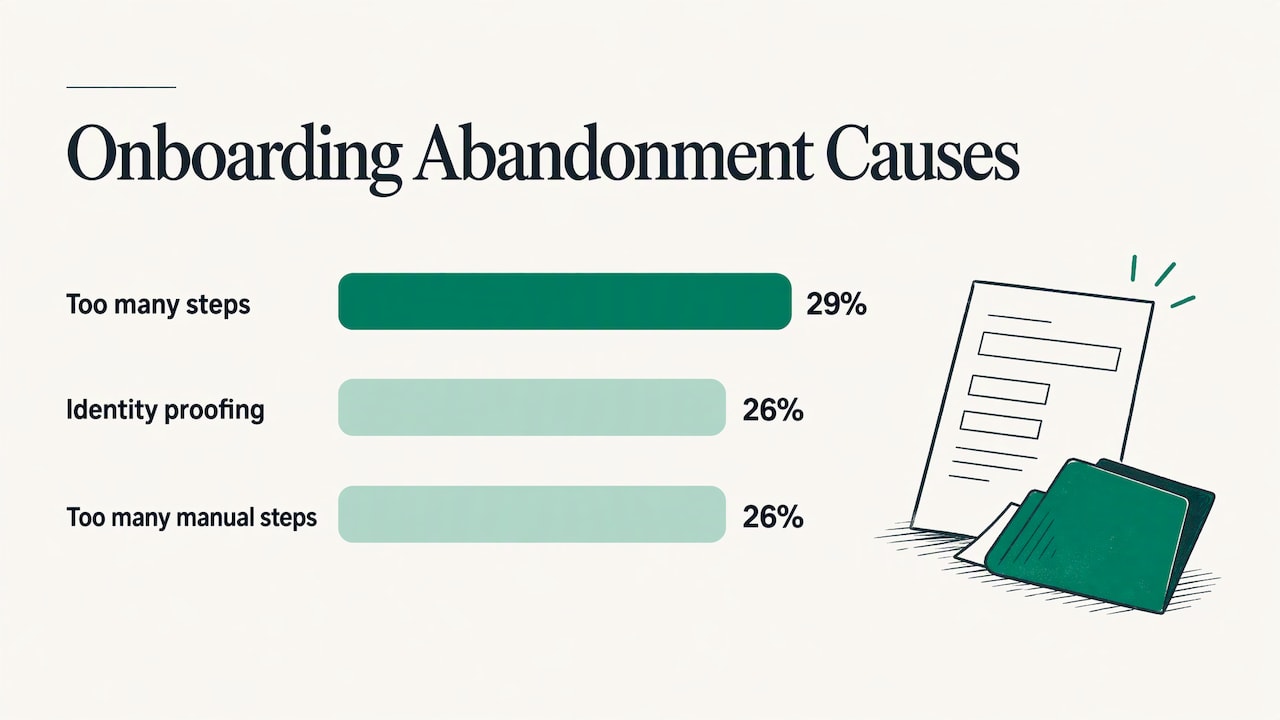
Drop-off is the other cost. An ABBYY survey from 2022 found that 9 out of 10 organizations see abandonment at onboarding of up to 40%. The top three causes were too many steps (29%), identity proofing (26%) and too many manual steps (26%). Each of those is something a well-built workflow can shorten or smooth.
Which steps to automate
A useful rule comes from separating two kinds of step. Leapforce’s research splits onboarding into steps that tell the customer something (messages) and steps that grant them something (access, API keys, billing subscriptions). Automate the telling from start to finish. Put every grant behind a verification level you wrote down in advance.
The reason is reversibility. A wrong email is embarrassing. A wrong account provision or billing start is hard to undo.
Good candidates for full automation
- Welcome and next-step messages. Sent the moment a deal closes or a form is submitted.
- Reminders. A nudge when a document, payment or confirmation is overdue.
- Follow-ups. A check that a customer has completed the step they were asked to do.
- Check-ins. A short message a few days in asking whether anything is blocked.
- Internal task creation. Each new customer opens the same checklist for the right people.
- Status visibility. Everyone can see which customers are on track and which are stuck.
Signwell’s guidance lists a similar starting set: intake and data collection, agreements and e-signatures, reminders and follow-ups, internal task creation and status visibility. It also notes that automation works best when the underlying process is already consistent, with defined owners, triggers, expected results and timeframes.
Steps to keep human or gated
- Anything that grants access or starts billing. Gate it behind a written check.
- High-value or complex accounts. IBM advises that the goal is to augment your team, not remove people, with clear escalation triggers and criteria for when a person steps in.
- At-risk customers. A customer who has gone silent for a set number of days should reach a person, not a fourth automated reminder.
- Exceptions. Custom terms, unusual requests and disputes.
How to build the workflow, step by step
1. Write down the process as it really runs
Sit with the people who do onboarding today and list every step in order, including the ones that live in someone’s inbox or memory. Automating a process that differs from person to person only makes the inconsistency faster. This is why we begin every engagement by understanding the workflow before building anything: the map is the foundation, and it is where most of the value is found.
2. Name an owner, a trigger and a deadline for each step
For every step, write four things: who owns it, what event starts it, what “done” looks like and how long it should take. “Send the intake form” becomes: owner is the account manager, trigger is the signed agreement, done is a completed form, deadline is two business days. If you cannot fill in all four, the step is not ready to automate.
3. Define what “first value” means
Onboarding ends when the customer gets the result they bought, not when the kickoff call happens. Write one sentence for each type of customer: when this person does this specific thing and confirms this outcome, onboarding is complete. Everything you build should shorten the path to that sentence.
4. Split messages from grants
Mark each step as telling or granting. Telling steps go on full automation. Granting steps get a verification rule: what proof is needed, and who approves when the proof is missing.
5. Choose the channel your customers answer
Email is easy to ignore. Many customers reply faster by text, especially for short confirmations, reminders and quick questions. Text-based follow-up suits steps like confirming a time, requesting a missing item or checking that a customer is unblocked.
6. Build it into the tools you already use
A workflow that lives outside the systems your team opens every day gets abandoned. Connect the automation to where records, calendars and customer contacts already sit, so nobody has to maintain a second system by hand.
7. Launch with one customer type, then widen
Start with the most common onboarding path. Run it, watch where customers stall, fix the rules, then add the next path. Onboarding is never finished on launch day, so plan for revisions from the start.
A worked example: a services business with a ten-step onboarding
Take a small firm that signs about twenty new clients a month. Onboarding has ten steps: agreement, intake form, payment, kickoff scheduling, access setup, data upload, a training session, a first deliverable, a check-in and a sign-off.
Here is how it divides.
| Step | Automate? | Why |
|---|---|---|
| Welcome message | Fully | Pure telling, identical every time |
| Intake form request and reminders | Fully | Repeatable, easy to trigger |
| Payment reminder | Fully | Message only; a person confirms the payment status |
| Kickoff scheduling | Mostly | Automated invitation, human handles reschedules |
| Access setup | Gated | A grant: needs a verification check |
| Data upload reminders | Fully | Repeatable follow-ups |
| Training session | Human | Relationship-building |
| Check-in after first week | Automated, with escalation | A person steps in on a negative or missing reply |
| Sign-off | Human | Confirms first value |
Six of ten steps run without anyone touching them, three are partly automated, and the people on the team spend their hours on the training and sign-off conversations that decide whether the customer stays.
Onboarding for event hosts: the same logic, a different customer
Onboarding does not only mean software customers. An event host onboards guests: collecting RSVPs, answering the same questions about parking and start times, sending reminders and taking headcounts. The steps are repetitive, time-sensitive and well suited to text.
Our Autonomous SMS Event Coordinator is built for this case. It automates guest interactions such as RSVPs, questions, polls and reminders, so the host is not answering the same message fifty times. Because guest texting depends on permission, we publish how that works on our SMS consent page.
Missed calls are an onboarding problem too
For many businesses, the first contact is a phone call. If nobody picks up, the relationship may end before it starts. Automated text follow-up to a missed call keeps that inquiry alive and moves the person toward the first onboarding step while the interest is fresh. Our Missed Call Recovery service is designed for exactly this gap.
How to measure whether it works
Counting messages sent tells you nothing. Measure what changes for customers and for your team.
- Time to first value. Days from signed deal to the result the customer bought. This is the headline number.
- Stalled steps. Which step holds customers longest. That is where to redesign next.
- Completion rate per step. Where customers drop off, echoing the abandonment causes above.
- Escalation rate. How often a person had to step in, and whether the trigger was right.
- Team hours per new customer. The admin time that automation was meant to return.
- Customer confirmation. A short check that the customer felt the process was clear.
Compare like with like: measure by customer type, since a simple account and a complex one will never onboard at the same speed. Set a baseline before launch so the change is visible.
Common mistakes
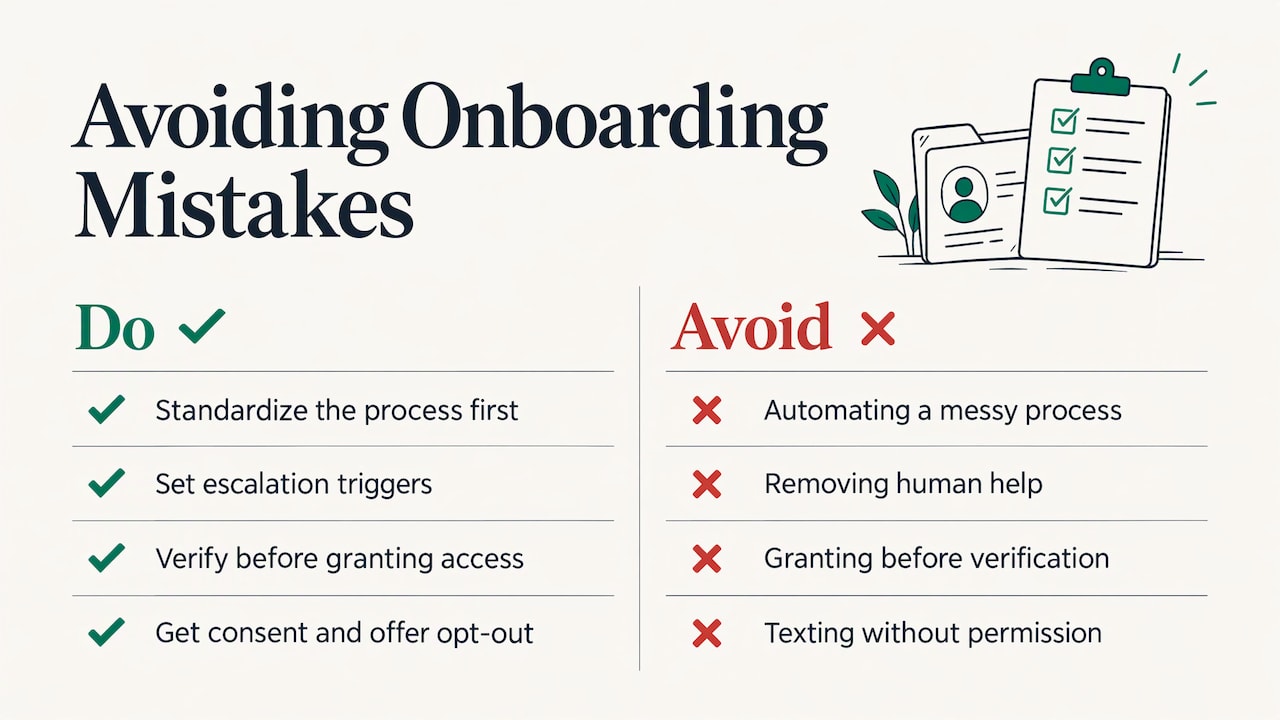
Automating a messy process. If two staff members onboard differently, the automation inherits the confusion. Fix the process first.
Removing people entirely. Customers who need a human and cannot reach one leave. Set escalation triggers in advance.
Granting before verifying. Access and billing steps need written rules. Messages are cheap to fix; provisioning is not.
Too many steps. Since too many steps was the leading cause of abandonment in the ABBYY survey, cut steps before automating them.
Treating launch as the finish. Customers behave differently from the way you predicted. The workflow needs reviewing and adjusting after go-live.
Texting without permission. Automated texts need the recipient’s consent and a clear way to opt out. Build that into the workflow from the start, not afterward.
Where a custom build fits
Off-the-shelf onboarding platforms are designed around a generic process. If your steps differ, you end up bending your work to fit the software. A tailored build starts from your steps instead.
That is how we work at GLPS Memphis. We focus on practical technology that integrates with your existing workflows and keeps complexity low, and we study how your operation runs before we build. We also keep supporting and improving the system after launch, which matters because an onboarding workflow needs tuning as you learn from real customers.
Putting Project G3 to work on onboarding
Project G3 is our AI-powered assistant for tasks, reminders, check-ins and follow-ups, the very pieces that make up most of an onboarding sequence. Instead of someone tracking who owes what, the assistant keeps the work moving and the follow-ups on schedule.
If your onboarding depends on someone remembering to chase a form, confirm a time or check in after the first week, that is the work to hand over. For onboarding built around texting, guest coordination or missed calls, we also offer the SMS Event Coordinator and Missed Call Recovery. To talk through your workflow, start with our IT consulting page, or see everything we offer on our services page.
FAQ
What is onboarding automation?
It is software that performs the repeatable tasks of bringing on a new customer: welcome messages, document requests, reminders, task assignment and status updates. Your team stays involved for judgment calls and relationships. The aim is to remove the chasing, not the people.
How do I automate the client onboarding process?
Write down your real process, assign an owner, trigger and deadline to every step, and define what first value means. Automate the steps that only tell the customer something, gate the ones that grant access, and launch with your most common customer type. Then review the results and adjust.
Which onboarding steps should stay manual?
Keep a person on high-value or complex accounts, exceptions, at-risk customers and anything that grants access or starts billing without a written verification. Relationship moments such as a training session or final sign-off also belong with your team.
Can text messages be part of onboarding automation?
Yes. Text works well for short confirmations, reminders and quick check-ins, and it is how many customers and event guests prefer to reply. Make sure recipients have given consent and can opt out. Our SMS consent page explains how we handle that.
Sources
- IBM: Customer onboarding automation
- Signwell: Client onboarding workflow
- Leapforce: Verify before you grant
- The B2B Marketer: B2B onboarding efforts still lag
- ABBYY: Customer onboarding drivers and pain points survey
Leave a Reply