
The main benefit of IT consulting is that someone who has solved your kind of technology problem before looks at your operation, tells you what to fix first, and helps you build or buy only what pays off. That means fewer wasted software purchases, fewer manual handoffs, and customer communication that does not depend on someone remembering to follow up. At GLPS Memphis, IT consulting starts with understanding your workflow before any system is built, and that order is what turns advice into results.
This guide covers who benefits, what each benefit looks like in a real small or midsize business, and how to tell whether consulting fits your situation.
TL;DR
- IT consulting gives you specialist knowledge you would otherwise have to hire full time, for the length of the project you need.
- The biggest savings usually come from removing manual steps and duplicate tools, not from cheaper hardware.
- Good consulting reduces risk: security gaps, compliance exposure and fragile systems that only one person understands.
- Workflow automation, custom software and automated customer messaging (such as missed call recovery) are where small teams see results fastest.
- The best engagements begin by mapping how work actually happens and keep improving the system after launch.
Table of Contents
- What an IT consultant actually does
- Benefit 1: Better technology decisions
- Benefit 2: Expertise you do not have to hire full time
- Benefit 3: Lower costs, mostly from removing friction
- Benefit 4: Less risk
- Benefit 5: Workflow automation that fits how you work
- Benefit 6: More reliable customer communication
- Benefit 7: A system that can grow or change
- Is IT consulting right for your business?
- How to get the most from an engagement
- How GLPS Memphis helps
- FAQ
- Sources
What an IT consultant actually does
An IT consultant is a technology professional who advises and supports businesses in designing, developing and carrying out technology projects that serve business goals. According to CIO’s overview of the role, that includes assessing a company’s infrastructure, its cybersecurity profile, software performance and data operations. Much of the work is conversation: meeting with the people who run the business to decide what to update, replace or leave alone.
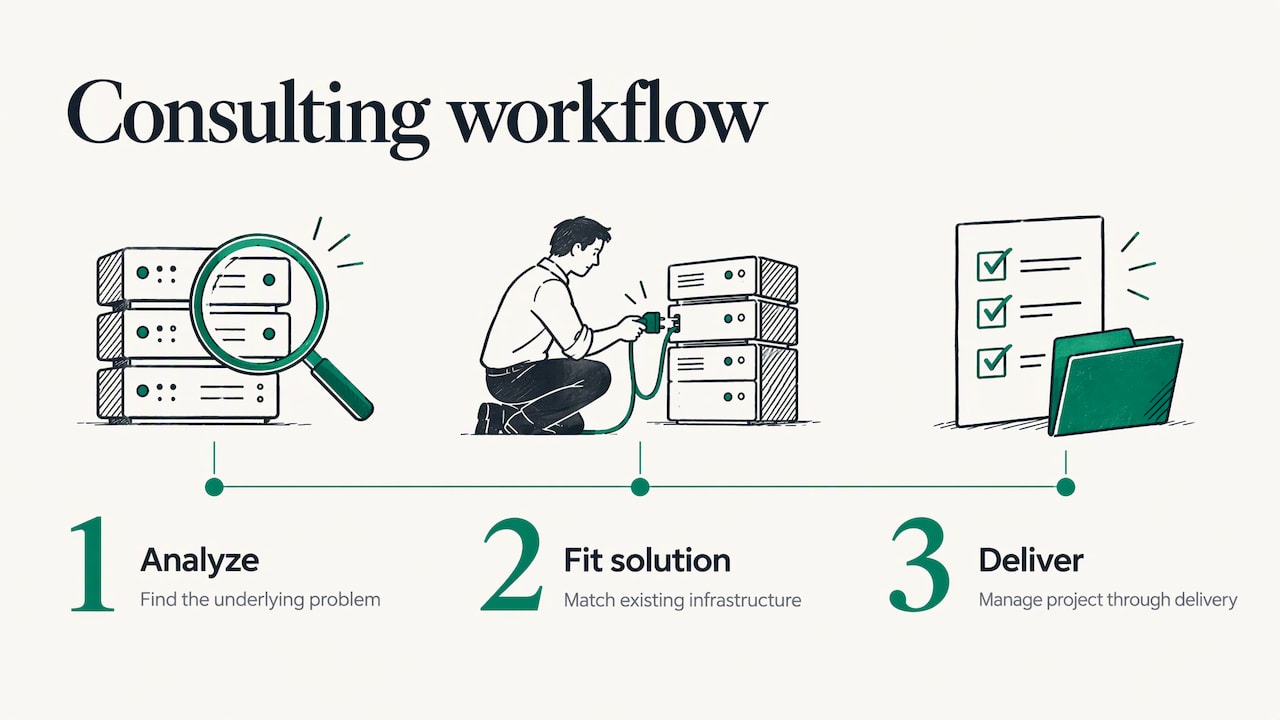
The work tends to follow three steps: find and analyze the problem, propose a solution that fits the infrastructure you already have, and manage the project through delivery, as Robert Half describes the consultant workflow. A broad view matters because the problem a client names is often not the underlying one. A team that says “our software is slow” may really have an approval step that waits on one person’s inbox.
For a business owner, the practical meaning is simple. You get a person or team whose job is to connect what your business needs with what technology can do, without that being a side task for you or your busiest employee.
Benefit 1: Better technology decisions
Most small businesses buy technology one problem at a time. A scheduling tool here, a texting app there, a spreadsheet that grew into a database. Each purchase made sense alone. Together they create overlapping subscriptions, data that lives in three places and staff who retype the same information.
A consultant looks at the whole picture first. The questions are usually plain ones:
- Which tools do people actually open every day?
- Where does information get copied by hand from one system to another?
- What happens when a task is missed, and who notices?
- Which of these problems are worth solving now, and which can wait?
The answer is often a short, ranked list rather than a big project. That ranking is the benefit. It keeps you from spending on the loudest problem when a quieter one costs more every week.
Our guide to business software integration for small teams walks through how connecting the tools you already own can remove a lot of this duplication before you buy anything new.
Benefit 2: Expertise you do not have to hire full time
Organizations bring in consultants to get specialist advice, an independent read on their problems and opportunities, and to fill skill gaps when hiring a permanent employee with those skills is not viable, as ManageEngine explains. Deltek lists expertise and specialized knowledge not readily available in-house as the first benefit of consulting.
For a company with 5, 20 or 80 employees, this matters in a concrete way. You probably do not need a full-time software architect, a security specialist and an automation engineer. You need each of them for a few weeks, at the moment a decision is being made. Consulting lets you buy that expertise in the size of the problem.
It also protects you from the single-person trap, where one employee built the system, knows how it works and is the only one who can change it. A consultant who documents the workflow and builds around it leaves you with something your team can run.
Benefit 3: Lower costs, mostly from removing friction
Deltek lists cost savings from identifying inefficiency and recommending cost-effective solutions among the core benefits. In practice, the savings in a small business come from a few predictable places:
| Where the cost hides | What it looks like | What consulting changes |
|---|---|---|
| Manual re-entry | Staff copy data between a form, a spreadsheet and a calendar | Systems connected so data enters once |
| Missed follow-ups | Leads, guests or customers go quiet because no one replied | Reminders and follow-ups handled automatically |
| Overlapping tools | Several subscriptions that do similar jobs | One agreed toolset |
| Rework | Fixing errors caused by unclear handoffs | A mapped process with clear owners |
None of these show up as a single line on a budget. They show up as hours, delays and lost business. That is why a workflow review often finds more savings than a hardware or licensing review.
Our article on business process delays explains where these slowdowns come from and how to trace them in your own operation.
Benefit 4: Less risk
Security, data protection and regulatory compliance are another category Deltek names under risk mitigation. For a small business, the risk is usually not an exotic attack. It is ordinary gaps: shared passwords, unreviewed email settings, old accounts of former employees, and systems nobody has looked at in years.
A consultant reviews these as part of assessing your infrastructure. If your needs go deep into penetration testing, risk assessment or staff phishing tests, specialized providers such as cybersecurity testing and risk assessment services exist for that work, and a consultant can help you scope it.
Risk also includes operational fragility. If a text reminder system, a booking tool or a customer inbox fails silently, nobody knows until a customer complains. Building monitoring and clear ownership into the system is part of reducing that risk.
Benefit 5: Workflow automation that fits how you work
This is where the benefits become visible to your staff and customers. Automation done well removes the small repetitive tasks that fill a day: sending reminders, chasing confirmations, checking in, logging a follow-up.
GLPS Memphis builds around that idea. Our core product, Project G3, is an AI-powered assistant that streamlines tasks, reminders, check-ins and follow-ups, aimed at the disorganized workflow management many businesses live with. It is designed to work inside existing operations rather than ask you to replace them.
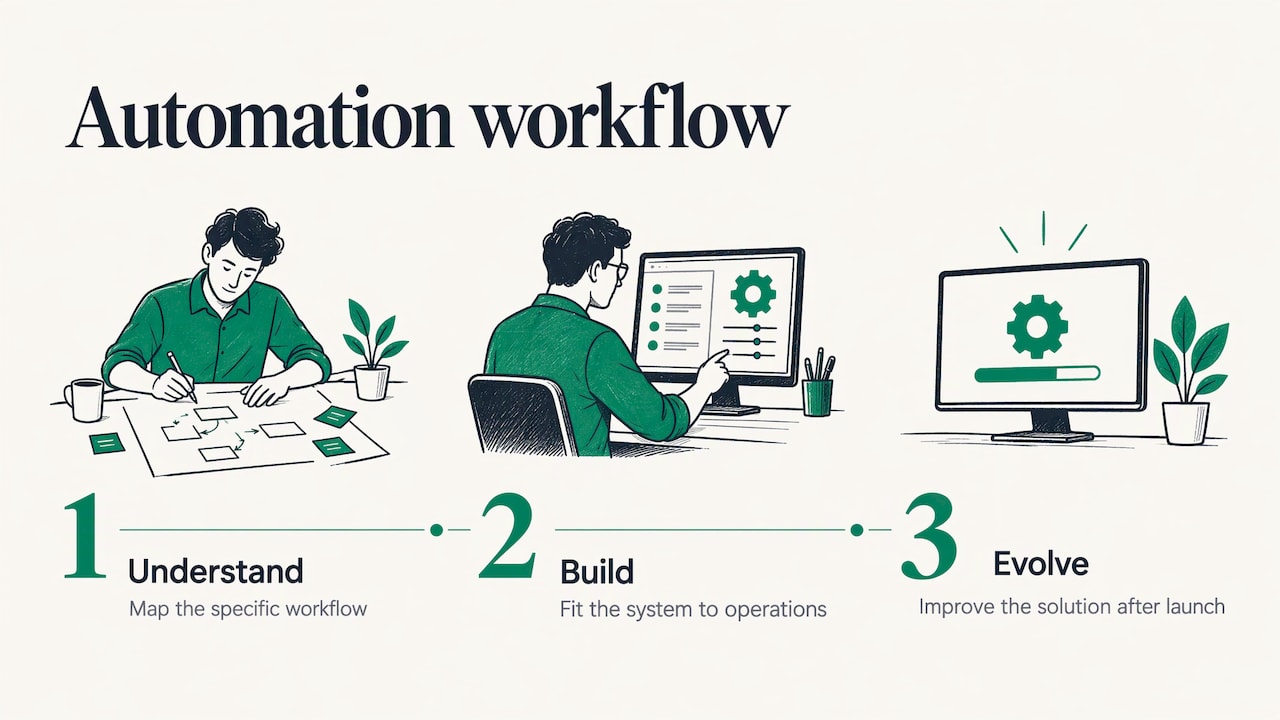
The approach matters as much as the tool. We start by understanding your specific workflow, then build the system, and the solution keeps evolving after launch. A tool that fits the way your team already works is the one that gets used.
When a standard product does not cover your process, the answer may be software built for you. Our guide to custom business software and when it pays off helps you judge when that step makes sense.
Benefit 6: More reliable customer communication
Customers judge a business by how quickly and clearly it responds. Two situations show how consulting turns into better communication.
Missed calls
A call that goes unanswered while you are with a customer, on a job site or closed for the night is a lost chance if nobody follows up. Automated text messages sent after a missed call let the person know you received their call and invite them to continue the conversation by text. Missed Call Recovery is our service for this, and our guide to how missed call text back works and how to set it up explains the mechanics. Because these are text messages to real people, consent matters, and our SMS consent page explains how we handle it.
Events
Event hosts face a different version of the same problem: dozens or hundreds of guests, each with questions, RSVPs and last-minute changes. Our Autonomous SMS Event Coordinator automates guest interactions, including RSVPs, questions, polls and reminders, so the host is not answering the same text fifty times. The goal is better engagement and clearer communication without adding staff time.
Benefit 7: A system that can grow or change
Businesses change. They add locations, services, seasons and staff. Deltek lists scalability and flexibility, the ability to adapt quickly to market changes, among the benefits of consulting.
The practical test is whether your systems can absorb change without a rebuild. A mapped workflow, connected tools and documented rules make it possible to add a step, a channel or a team member without starting over. This is also why support after launch matters. The first version of any system teaches you something about how the work really happens, and the second version should reflect it.
Is IT consulting right for your business?
Consulting tends to pay off when one or more of these is true:
- You are doing the same task by hand every day. Reminders, confirmations, data entry and follow-ups are the classic candidates.
- You have several tools that do not talk to each other. Staff act as the connection between them.
- You are about to make a significant technology purchase. An independent view before you commit is worth more than one after.
- Customers or leads slip through the cracks. Missed calls, unanswered messages and late replies all have a cost.
- One person holds all the knowledge. Documenting and simplifying the system reduces that dependency.
- You need a specialist’s knowledge for a defined period. A project is cheaper than a permanent hire for a short, focused need.
If two or three of these sound familiar, a short conversation about your workflow is a sensible next step.
How to get the most from an engagement
The quality of the result depends partly on how you prepare. Before the first meeting:
- Write down the problem in business terms. “We lose about a day a week to confirmations” is more useful than “we need a new system.”
- List the tools you use now, including spreadsheets and shared inboxes.
- Identify who touches the process, from the first request to the final follow-up.
- Decide what success looks like. Fewer missed leads, faster replies or hours saved each week are all measurable.
- Name one person on your side who can answer questions and approve decisions quickly.
A consultant who begins with your workflow rather than a product pitch is working in your interest. The workflow comes first, the technology second.
How GLPS Memphis helps
GLPS Memphis offers IT consulting and custom software focused on practical technology that fits into your existing operations. We aim to minimize complexity and maximize ongoing productivity by understanding each client’s operational needs first and continuing to support and improve the system after launch.
Whether the need is a task and follow-up assistant, automated event communication or recovering missed calls, the starting point is the same: a conversation about how your work gets done. See our IT consulting page or our full list of services to begin.
If you already know which problem costs you the most, start with the matching page: Project G3 for tasks and follow-ups, the SMS Event Coordinator for event hosts, or Missed Call Recovery for calls that go unanswered.
FAQ
What are the main benefits of IT consulting?
The core benefits are specialist expertise, cost savings from removing inefficiency, higher productivity through streamlined processes, lower security and compliance risk, and the flexibility to adapt as your business changes. Deltek’s guide lists these same categories. For small businesses, the most visible gains are usually fewer manual tasks and better follow-up with customers.
When should a business hire an IT consultant?
Hire one when a recurring problem costs you time or customers, when you are choosing a significant system, or when you need a skill you cannot justify hiring full time. Repeated manual work, disconnected tools and missed customer messages are common signals.
What does an IT consultant do day to day?
Much of the time goes to meeting with clients about what to update and maintain, assessing systems, and planning and managing projects, according to CIO. On a build engagement, that includes designing the solution around your existing workflow and supporting it after launch.
Can IT consulting help with customer communication?
Yes. Automated reminders, follow-ups, event messaging and text replies after missed calls are all ways technology keeps customers informed without adding workload. At GLPS Memphis, Project G3, the SMS Event Coordinator and Missed Call Recovery are built for these situations.
Sources
- What is an IT consultant? Roles, types, salaries, and how to become one (CIO)
- What is IT Consulting? A Comprehensive Guide (Deltek)
- What is an IT consultant? Key role and job description (ManageEngine)
- What does an IT consultant do? Key roles and skills (Robert Half)
Leave a Reply